
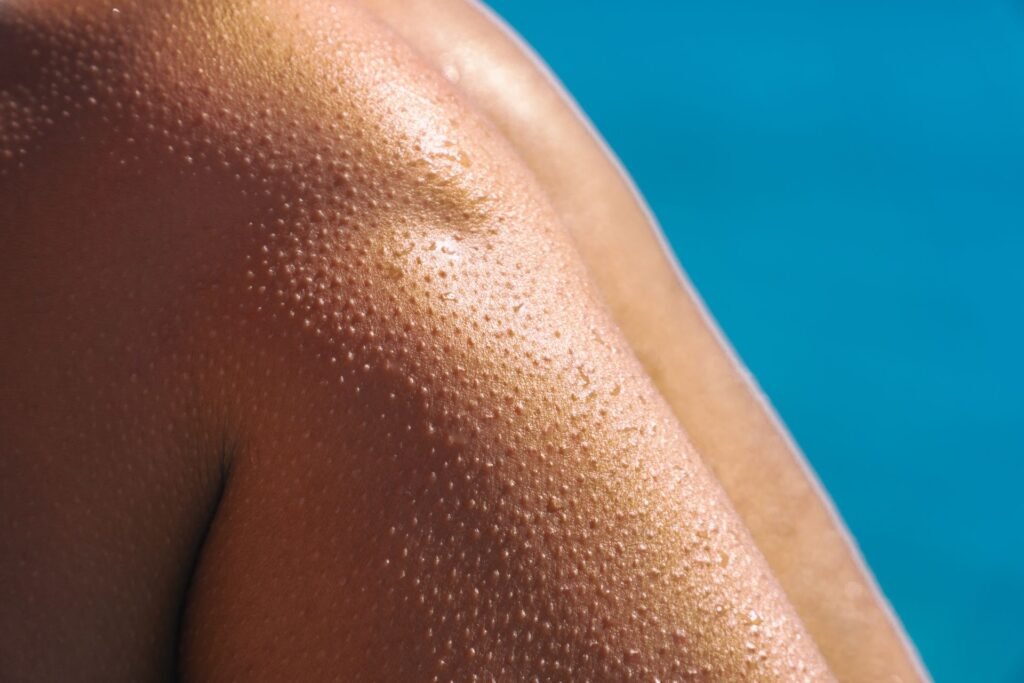
Every Indian summer follows a familiar script. The heat climbs, your face turns shinier by mid-morning, and breakouts start arriving in places they usually don’t. It’s a little disheartening, especially if you’ve been looking after your skin all year. The reassuring part is that almost all of it is your skin reacting sensibly to the weather — and a few gentle adjustments handle most of it.
Here’s what’s happening, and what genuinely helps, without stripping your skin or adding ten new steps.
Why heat makes skin oilier
Your oil glands are sensitive to temperature. When skin warms, the sebaceous glands deliver more sebum — the skin’s natural oil. This is well documented: a classic study found sebum excretion changes by roughly 10% for every 1°C change in skin temperature (Cunliffe & Shuster, British Journal of Dermatology, 1970), and a 2025 randomised trial reported that exposure to 32°C raised both sebum production and skin inflammation markers versus 22°C (Environmental Research, 2025). A bit of sebum is a good thing; it keeps skin comfortable and protected. The trouble starts when that extra oil meets the rest of an Indian summer day.
You also sweat more. Sweat itself is mostly harmless, but as it mixes with excess sebum, dead skin cells and the day’s pollution, it can settle into pores and contribute to clogging — the chain that leads to summer breakouts. Dermatologists widely note that oil-related breakouts tend to rise through the hottest, most humid months. So if your skin feels like it changes personality in May, that’s a very ordinary thing for it to do.
High humidity adds one more twist: it can leave the skin’s barrier a little more vulnerable even as the surface feels greasy. That combination — oily on top, under-supported underneath — is why summer skin often feels both shiny and sensitive at once.
The most common summer mistake (and it’s a kind one)
When skin gets oily, the instinct is to wash it more and harder, and to chase that squeaky-clean feeling. It makes complete sense. Unfortunately it tends to backfire: stripping the skin of its natural oils prompts it to produce even more to compensate, and a harsh routine can leave the barrier raw under all that shine. If your skin feels tight after cleansing, that’s usually a sign you’ve gone a step too far, not a sign of “clean.”
The gentler path almost always works better in the heat. The goal isn’t to dry the skin out — it’s to keep it balanced.
A simple, summer-friendly routine
You can adapt what you already use rather than buy a whole new shelf:
- Cleanse gently, twice a day and after heavy sweating. A mild cleanser removes sweat, oil and pollution without stripping. After a sweaty commute or workout, it’s better to blot the sweat than scrub it, since friction just spreads bacteria around.
- Lighten your textures. Swap rich creams for a lightweight gel moisturiser. Skin still needs hydration in summer — heavy occlusive layers just trap heat and feel suffocating. (If you’re in a hard-water city, that post-wash tightness might be partly your tap water, not only the heat — more on that in how hard water affects your barrier.)
- Let one calm active do the heavy lifting. Niacinamide is a good summer friend: it helps regulate oil, soothes redness and supports the barrier, all without the irritation a stack of strong actives can cause. It’s also why we’re partial to a sensible 5%, rather than a big number on the label.
- Keep sun protection non-negotiable. It feels counter-intuitive when you’re already oily, but unprotected UV thickens the outer skin layer and worsens both breakouts and the dark marks they leave behind. A lightweight, non-greasy sunscreen you’ll actually reapply is the one to reach for.
- Do less, not more. Pause the harsh scrubs and the everything-at-once routine for the hottest months. A short, gentle routine your barrier can tolerate will outperform an aggressive one almost every time.
One quick clarification: acne or heat rash?
Not every summer bump is acne. Heat rash appears when sweat ducts get blocked and trap sweat under the skin — typically small, uniform, very itchy bumps in areas where skin folds or clothing rubs (Apollo Pharmacy, 2025). Acne is clogged pores with oil, dead cells and bacteria. They need different care: heat rash mostly wants cooling, loose breathable clothing and soothing, while acne wants gentle cleansing and oil-balancing. If you’re genuinely unsure, a dermatologist can save you weeks of treating the wrong thing.
Where this fits
Heat is one of four environmental forces that make Indian skin its own special case — together with UV, hard water and pollution. We tie the whole picture together in why your skincare doesn’t work in India. The encouraging takeaway is that summer skin rarely needs more — it usually needs gentler, lighter and more consistent.
We’re still developing pH Matter’s formulas, with Indian heat and humidity built into the brief from the start. If you’d like a note when they’re ready, leave your email — no spam, just the science as it comes.
FAQ
Why is my skin so much oilier in summer?
Heat makes your oil glands more active, so they produce more sebum. Mixed with sweat, dead cells and pollution, that extra oil can clog pores and cause breakouts.
Should I wash my face more often when it’s hot?
Gently, yes — twice daily and after heavy sweating — but not harshly. Over-washing strips the skin and can trigger more oil. Tightness after cleansing is a sign to ease off.
Do I still need moisturiser if my skin is oily in summer?
Yes, just a lighter one. A gel moisturiser hydrates without trapping heat. Skipping moisturiser entirely can prompt the skin to produce even more oil.
Is sunscreen going to make my summer acne worse?
Only if it’s heavy and pore-clogging. A lightweight, non-comedogenic formula actually helps, because unprotected UV worsens breakouts and darkens post-acne marks.
How do I tell summer acne from heat rash?
Heat rash is usually small, uniform, very itchy bumps in folds or where clothing rubs, caused by blocked sweat ducts. Acne is clogged pores. When in doubt, a dermatologist can tell them apart quickly.
Written by the pH Matter Editorial team. Educational only, and not a substitute for advice from a qualified dermatologist for persistent or severe breakouts.